

Only tempered, oven-safe borosilicate glass (rated up to 425°F / 218°C) can go in an air fryer. Never use ordinary soda-lime glass, drinking glasses, decorative dishes, or cold glass bakeware taken straight from the refrigerator or freezer.
Because air fryer convection heating is intense and localized, extreme thermal differentials between the hot top surface and cool bottom can cause non-tempered glass to experience thermal shock and shatter violently inside your basket.
Quick Verdict: Can You Put Glass or Pyrex in an Air Fryer?
Yes, you can safely put glass in an air fryer, but ONLY if it is certified oven-safe (such as tempered Pyrex, Anchor Hocking, or borosilicate glass) and ONLY when strict thermal shock protocols are followed. Never use ordinary drinking glasses, Mason jars, or chipped glassware. Furthermore, never transfer cold glass from the fridge into a hot air fryer, and never place hot glass onto cold granite or wet surfaces, or the glass will violently shatter.
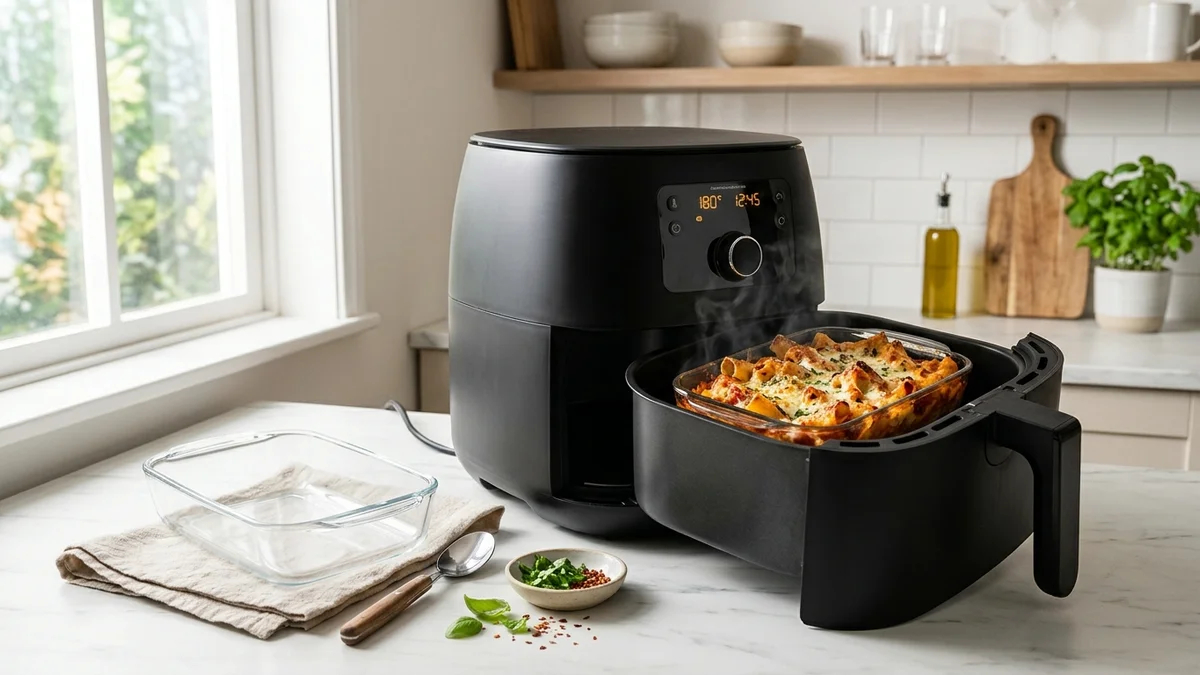
Table of Contents
- • 1. The Physics of Glass Explosions: Thermal Shock & Differential Expansion
- • 2. Borosilicate vs. Soda-Lime Pyrex: The Critical Chemical Difference
- • 3. How to Identify Borosilicate vs. Soda-Lime Glass at Home
- • 4. What Glassware Is 100% Forbidden (Jars, Duralex, Corelle & Cups)
- • 5. The "Dry Floor" Thermal Hotspot Hazard: Why You Must Add Liquid
- • 6. Airflow Clearance & Glass Bakeware Sizing Matrix
- • 7. Baking Physics Benchmark: Glass vs. Metal vs. Silicone Heat Transfer
- • 8. The Danger Zone: Post-Cooking Countertop Resting Rules
- • 9. Emergency Protocol: How to Safely Clean Up Shattered Glass in an Air Fryer
- • 10. Official Brand Guidelines (Pyrex, Anchor Hocking, Ninja, Cosori)
- • 11. Interactive Glassware & Thermal Shock Safety Evaluator
- • 12. Step-by-Step: How to Safely Cook with Glass in an Air Fryer
- • 13. Frequently Asked Questions (Air Fryer Glassware FAQs)
1. The Physics of Glass Explosions: Thermal Shock & Differential Expansion
To understand why glass can catastrophically shatter inside an air fryer, you must examine how an air fryer heats compared to a conventional thermal oven. A traditional oven heats a large 5-cubic-foot cavity gradually, surrounding cookware with slow, ambient radiant warmth.
An air fryer, by contrast, operates like a high-intensity thermal wind tunnel. It pairs a glowing nichrome heating coil running at 700°F–800°F with an overhead cyclonic fan spinning at 2,000+ RPM.
How Differential Thermal Expansion Causes Explosive Failure
Glass is an exceptional thermal insulator with poor heat conductivity. When 400°F air blasts the top rim of a glass dish while the thick base remains at room temperature, the outer glass molecules expand rapidly while the inner molecules remain stationary. This creates massive mechanical tension (upwards of 25,000 PSI). When this tension exceeds the glass's ultimate tensile strength, it releases all at once—violently detonating the dish into sharp shards.
This phenomenon is called Thermal Shock. It does not just occur while heating; over 70% of reported kitchen glassware explosions happen after cooking when home cooks place boiling-hot glass onto cold quartz or granite countertops.
2. Borosilicate vs. Soda-Lime Pyrex: The Critical Chemical Difference
Many consumers do not realize that not all "Pyrex" glassware is the same material. In 1998, the licensing and manufacturing of Pyrex in the United States changed formulas dramatically:
Borosilicate Glass (pyrex - lowercase)
Manufactured with silica and boron trioxide. Found in vintage Pyrex, European-made Pyrex, and laboratory equipment (OXO Good Grips glass).
- Thermal Expansion Coeff: 3.3 × 10⁻⁶ /K (Ultra-low)
- Thermal Shock Delta: Withstands Δ300°F (170°C) rapid change
- Air Fryer Rating: ✓ Superior Resistance
Tempered Soda-Lime Glass (PYREX - uppercase)
Manufactured with silica, soda, and lime, heat-treated for compressive surface strength. Standard for modern US-made Pyrex and Anchor Hocking.
- Thermal Expansion Coeff: 9.0 × 10⁻⁶ /K (3x higher expansion)
- Thermal Shock Delta: Withstands only Δ100°F–150°F rapid change
- Air Fryer Rating: ∼ Requires Strict Caution
The Takeaway: Tempered soda-lime glass is more durable against physical impact drops, but significantly more fragile when exposed to rapid air fryer temperature shifts. Always treat modern Pyrex with extra care.
3. How to Identify Borosilicate vs. Soda-Lime Glass at Home
Before placing any glass dish into your air fryer, you can determine its chemical composition and thermal shock threshold using two simple non-destructive tests:
Look Through the Rim Edge in Natural Light
Hold the glassware up to a sunny window and look directly into the exposed rim edge:
- ✓ Clear or Faint Gray/Blue: Borosilicate glass. Contains boron trioxide without excess iron. High thermal resistance (Δ300°F).
- ∼ Distinct Green / Cyan Tint: Tempered Soda-Lime glass. The greenish hue comes from iron oxide additives. Vulnerable to thermal shock (Δ100°F–150°F).
Check the Bottom Stamp Lettering
Examine the embossed trademark on the underside of your baking dish:
- ✓ Lowercase "pyrex": Indicates European-made or vintage Corning Glass Works borosilicate.
- ∼ Uppercase "PYREX": Indicates modern US-manufactured Corelle Brands tempered soda-lime glass. Requires strict room-temperature handling.
4. What Glassware Is 100% Forbidden (Jars, Duralex, Corelle & Cups)
Never make assumptions about glassware. Unless a dish has an explicit factory-embossed stamp reading "Oven-Safe," it belongs nowhere near an air fryer. Here are the items that must NEVER be placed inside:
| Glassware Category | Common Kitchen Examples | Failure Mode & Hazard | Safety Verdict |
|---|---|---|---|
| Canning & Mason Jars | Ball, Kerr, Kilner glass jars | Designed for wet boiling baths, not dry 400°F air; fractures along seam lines | ✗ STRICTLY FORBIDDEN |
| Drinking Glasses & Tumblers | Water glasses, pint glasses, wine goblets | Non-tempered soda glass; localized coil heat cracks rim in under 2 minutes | ✗ STRICTLY FORBIDDEN |
| Duralex Tempered Glassware | Duralex Picardie tumblers, Lys glass bowls | Thermal shock rated only to 266°F (130°C); hot air fryer drafts exceed threshold | ✗ UNSAFE IN AIR FRYER |
| Corelle Vitrelle Dinnerware | Corelle white plates, dessert bowls | 3-layer laminated glass-ceramic; uneven direct radiant coil heat causes sudden seam separation | ✗ UNSAFE IN AIR FRYER |
| Pyrex Glass Measuring Pitchers | 1-cup, 2-cup, 4-cup measuring cups | Asymmetrical handle creates structural tension zones; handle can snap off under heat | ✗ AVOID IN AIR FRYER |
| Chipped or Scratched Pyrex | Vintage bowls with knife score lines | Surface micro-cracks concentrate structural tension; explodes under heat | ✗ NEVER USE |
| Glass Lids with Plastic Knobs | Saucepan covers, slow cooker lids | Plastic knobs melt and release toxic fumes; glass rim shatters against basket | ✗ STRICTLY FORBIDDEN |
5. The "Dry Floor" Thermal Hotspot Hazard: Why You Must Add Liquid
One of the least known manufacturer rules from both Corelle Brands (Pyrex) and Anchor Hocking is the "Liquid Buffer Rule":
Why Roasting Meat on Bare Glass Causes Fracturing
When cooking cuts of meat (like chicken breasts, pork chops, or sausage patties) in an empty glass dish, rendered animal fat drips onto the dry glass floor. Hot cooking oil quickly superheats to 375°F–420°F in isolated puddle spots, while dry portions of the glass floor remain much cooler. This severe, localized temperature delta creates micro-fractures directly underneath the grease pools.
The Manufacturer Mandate: Always cover the bottom of your glass dish with 2 to 3 tablespoons of water, vegetable broth, or a light film of cooking oil before adding food. The liquid conducts heat across the entire bottom plate uniformly, keeping temperature differentials within the safe tolerance envelope.
6. Airflow Clearance & Glass Bakeware Sizing Matrix
Even if your glass dish is 100% oven-safe, placing an oversized vessel into your air fryer basket ruins cooking performance and creates dangerous thermal hotspots.
The 1-Inch Perimeter Airflow Clearance Rule
Hot air must be able to circulate beneath and around all 360 degrees of the food. If a square Pyrex dish occupies the entire basket floor with zero gap against the sidewalls, it chokes convective circulation. Hot air bottlenecks above the dish, overheating the top glass surface to 450°F+ while the bottom remains cold—maximizing thermal shock risk.
| Air Fryer Capacity | Basket Floor Dimensions | Maximum Safe Glassware Dimension | Recommended Glassware Formats |
|---|---|---|---|
| Compact (2–3 Quarts) | 6.5" to 7.0" Diameter | 4.5" to 5.0" Maximum | One 6-oz to 8-oz glass ramekin or mini custard cup |
| Standard (4–6 Quarts) | 8.0" to 8.5" Square | 6.5" Square or 7.0" Round | Two 8-oz ramekins or one 1-quart round casserole dish |
| XL / Dual Basket (7–10 Qt) | 8.5" x 5.5" (Per Zone) | 6.5" x 4.0" Rectangular | Small mini loaf glass dish per zone (with 1" perimeter) |
| Toaster Oven Style | 11" x 12" Wire Rack | 8" x 8" Square Pyrex Dish | Brownie pan or shallow gratin dish (keep 3" from top coils) |
7. Baking Physics Benchmark: Glass vs. Metal vs. Silicone Heat Transfer
Culinary physics dictates how rapidly energy transfers from hot air into your batter or casserole. Review these thermal conductivity metrics:
| Cookware Material | Thermal Conductivity (W/m·K) | Baking Time Adjustment | Crust & Browning Performance | Shatter / Safety Rating |
|---|---|---|---|---|
| Tempered Glass (Pyrex) | 0.8 – 1.0 (Slow Insulator) | Add 15%–20% more time | Pale crust, even gentle center baking | ⚠️ Shock vulnerable |
| Anodized Dark Metal Pan | 205.0 (Ultra-Fast Conductor) | Standard recipe time (-25°F rule) | Crisp brown edges, rapid caramelization | ✓ 100% Shatter-proof |
| Food-Grade Silicone Mold | 0.15 – 0.25 (Flexible Insulator) | Add 10% more time | Soft tender crumb, effortless release | ✓ Completely indestructible |
| Glazed Ceramic Ramekins | 1.2 – 1.5 (Moderate Conductor) | Add 5%–10% more time | Superb heat retention, attractive presentation | ✓ Highly heat resilient |
8. The Danger Zone: Post-Cooking Countertop Resting Rules
The vast majority of air fryer glass disasters do not happen during cooking—they occur within 10 seconds of pulling the dish out of the machine. Review this critical countertop surface checklist:
Silicone and dry hardwood are thermal insulators. They absorb little heat from the glassware, allowing hot molecules to cool gradually at a uniform pace across the base.
Natural stone countertops are dense thermal heat sinks running at room temperature (68°F–72°F). When a 350°F glass bottom touches cold stone, heat transfers instantaneously out of the bottom contact zone while the sides remain hot—causing instant catastrophic fracturing.
Never place hot glassware directly into a sink to soak, and never set it on a damp dishcloth. Water rapidly flashes into steam on contact with 350°F glass, cooling that single microscopic point in milliseconds and triggering an immediate shatter.
9. Emergency Protocol: How to Safely Clean Up Shattered Glass in an Air Fryer
If an accidental thermal shock causes a glass dish to crack or shatter inside your air fryer basket, follow this 5-step safety procedure:
5-Step Glass Decontamination Procedure
- Step 1: Unplug and Let Cool for 60 Minutes: Turn off the circuit breaker or unplug from the wall. Never attempt to remove hot broken glass; hot tempered glass can continue spalling and popping sharp shards as it cools.
- Step 2: Discard All Open Food in the Kitchen: Tempered glass under high-velocity air drafts explodes with explosive force, scattering microscopic glass dust up to 10 feet away. Throw away any exposed food on nearby countertops.
- Step 3: Wear Cut-Resistant Gloves & Remove Large Shards: Use kitchen tongs to place large glass pieces into a cardboard box. Never place loose shards in a thin plastic trash bag that can tear and cut handlers.
- Step 4: The Fresh Bread / Damp Paper Towel Dab Method: Press a slice of soft sandwich bread or a damp paper towel firmly across the bottom crisper grates. The soft gluten structure embeds microscopic glass slivers that brooms and sponges miss.
- Step 5: Vacuum the Upper Fan & Heating Coil Cavity: Turn the cooled air fryer upside down and use a vacuum hose with a crevice attachment to clear any glass particles lodged in the overhead heating coils. If glass dust remains in the fan, it will spray into your food during future meals.
10. Official Brand Guidelines (Pyrex, Anchor Hocking, Ninja, Cosori)
Here is what the world's leading appliance and cookware manufacturers state in their official user manuals regarding air fryer glass safety:
"Do not use Pyrex glassware on or under direct heat sources, including stovetop burners, broilers, toaster ovens, or direct heating elements. While air fryers are convection appliances, models with high-intensity upper heating coils must not be used on broil settings with glassware."
"Anchor Hocking glassware is safe for use in preheated conventional and convection ovens up to 425°F. Always add a small amount of liquid to the dish prior to cooking foods that release juices. Never subject glassware to sudden temperature changes."
"Use only oven-safe cookware that fits comfortably inside the air fryer basket. Ensure containers do not touch the upper heating element. Avoid thermal shock when removing hot glassware by using silicone mats."
"Any oven-safe pan or mold (metal, glass, ceramic, or silicone) can be used in your Cosori air fryer. However, leave sufficient clearance around the vessel so cyclonic hot air can freely flow."
8. Air Fryer Glassware & Thermal Shock Safety Evaluator
Select your glassware material, food initial temperature, air fryer cooking heat, and planned countertop resting surface to calculate real-time Thermal Shock Risk and explosion safety.
9. Step-by-Step: How to Safely Cook with Glass in an Air Fryer
Follow this 5-step safety procedure every time you use glassware in any air fryer brand:
Verify the "Oven-Safe" Embossed Stamp
Inspect the base of the glassware in bright light. Look for the manufacturer's mark indicating oven suitability. Check for any chips or hairline scratches along the rim; discard or retire damaged glass immediately.
Bring Glassware and Food to Room Temperature
Never place chilled glassware straight from the refrigerator or freezer into a hot air fryer. Allow the food and container to sit on the kitchen counter for 20 to 30 minutes until room temperature is achieved.
Ensure a 1-Inch Airflow Perimeter Clearance
Place the glass dish centrally on the wire crisper plate. Ensure at least 1 inch of free space exists around the perimeter so convective drafts can cycle downward without creating localized heat bottlenecks.
Cap Air Fryer Temperature at 400°F (No Broil / Max Crisp)
Set your cooking program between 325°F and 385°F. Never activate high-heat Broil, Grill, or Max Crisp (450°F) programs that expose glass rims to direct intense radiant coils.
Rest Hot Glass ONLY on Dry Silicone or Wood
Using heat-resistant silicone oven mitts, remove the glass dish and set it directly onto a dry silicone trivet or wooden cutting board. Keep it away from open windows, wet sinks, and cold natural stone countertops.
10. Frequently Asked Questions (Air Fryer Glassware FAQs)
Direct culinary science answers to the top user queries regarding Pyrex, glass bowls, and air fryer safety:
Can you put glass in an air fryer? ▾
Yes, you can put glass in an air fryer, but ONLY if the glassware is explicitly labeled oven-safe (such as tempered Pyrex, Anchor Hocking, or borosilicate glass) and you strictly prevent thermal shock. Ordinary glassware, drinking glasses, and Mason jars will shatter or explode under high convection heat.
Can Pyrex explode in an air fryer? ▾
Yes, Pyrex can shatter or explosively fail in an air fryer due to thermal shock. This happens when a cold Pyrex dish is placed into a preheated basket, or when a boiling-hot Pyrex dish is removed and placed directly onto a cold quartz/granite countertop, stainless steel sink, or damp towel.
What is the difference between borosilicate glass and soda-lime Pyrex? ▾
Borosilicate glass (found in vintage European pyrex and brands like OXO) contains boron trioxide, giving it an extremely low thermal expansion coefficient that resists temperature shocks of up to 300°F (170°C). Modern US Pyrex (uppercase PYREX) is made from tempered soda-lime glass, which resists mechanical drops but is significantly more vulnerable to thermal shock (tolerating only a 100°F–150°F rapid temperature shift).
Can you put a Mason jar in an air fryer? ▾
No, never put Mason jars or Ball canning jars in an air fryer. Canning jars are engineered for gentle, humid water-bath submersion, not intense dry convection airflow. The uneven rapid heat from an 800°F air fryer coil will crack or shatter canning glass.
What is the maximum temperature for glass in an air fryer? ▾
Oven-safe glassware manufacturers specify a maximum thermal cap of 425°F (218°C). However, in an air fryer, convective air velocity concentrates thermal stress on the upper rim; culinary safety boards recommend keeping air fryer temperatures capped at 375°F–390°F.
Can you preheat an air fryer with a glass dish inside? ▾
No. Never preheat an air fryer with empty glassware inside, nor place cold glass into a preheated air fryer. The sudden rush of 400°F air against room-temperature glass creates localized differential expansion that fractures the vessel.
Can you put chipped or scratched Pyrex in an air fryer? ▾
Never. Any hairline scratch, microscopic chip, or surface etching on tempered glass acts as a stress concentrator. Under rapid cyclonic airflow and heat cycling, internal tension releases violently, causing the dish to explode into thousands of tiny glass fragments.
Where should you place hot Pyrex when taking it out of an air fryer? ▾
Always set hot glassware onto a dry, heat-resistant silicone trivet, a wooden cutting board, or a dry cotton dish towel. Never place it directly onto cold stone countertops (granite, marble, quartz), metal racks, or wet surfaces.
Can you use glass lids in an air fryer? ▾
No. Glass lids usually feature plastic handles, silicone gaskets, or metal rim seals that cannot withstand 350°F+ dry convection. Furthermore, sealing a dish with a tight lid impedes the convection airflow necessary for air frying.
What is better for air fryer baking: glass, metal, or silicone? ▾
Dark metal pans and silicone molds are far superior to glass for air frying. Metal conducts heat rapidly, producing crisp edges on cakes and brownies, while silicone is completely shatter-proof and flexible. Glass is an insulator that slows down cooking and poses thermal shock risks.
Can you bake mug cakes or lava cakes in glass ramekins in an air fryer? ▾
Yes, oven-safe tempered glass ramekins (like Anchor Hocking 6-oz custard cups) work wonderfully for lava cakes and baked eggs at 325°F–350°F, provided they are at room temperature when placed into the basket.
What should you do if glass shatters inside your air fryer? ▾
Unplug the air fryer immediately and allow the entire machine to cool down completely for at least 1 hour. Discard all food in the basket and surrounding kitchen area. Remove the basket and vacuum out microscopic shards from the fan assembly and heating element before attempting to clean.
Related Air Fryer Guides & Calculators
Related Guides & Tools
Hand-picked next reads on this topic.