
Standing in your kitchen with a recipe calling for a 9x13 metal pan, but you only have a Pyrex glass dish? Or wondering why your brownies burned around the edges while staying raw in the middle? Glass and metal behave completely differently under oven heat. Learn when to bake in glass vs metal pans, why you must drop oven temp by 25°F for glass, browning differences for cakes and brownies, plus thermal shock safety rules.
Quick Answer: When to Use Glass vs Metal & The 25°F Rule
The Fundamental Rule: Metal is for baking (cakes, cookies, brownies, muffins, pastries, and breads), while glass is for cooking and casseroles (lasagnas, enchiladas, gratins, fruit crisps, and pies).
Glass vs Metal Bakeware Temperature & Time Converter
Jump to Sections in This Guide:
1. The Science of Heat Transfer: Why Glass and Metal Act Oppositely
To understand why your baked goods turn out dramatically different in a glass pan compared to a metal pan, you have to look at the three forms of heat transfer occurring inside your oven: conduction, convection, and radiation.
Thermal Conductor: Metals like aluminum and steel have exceptionally high thermal conductivity. They heat up almost instantly the moment they enter the oven.
- Transfers heat rapidly into the outer batter via direct contact conduction.
- Triggers early leavening reaction, pushing cakes and muffins skyward.
- Cools down rapidly once pulled out, stopping residual cooking quickly.
- Produces light, tender, delicately browned crumb textures.
Thermal Insulator + Radiant Sponge: Glass is technically a thermal insulator. It takes noticeably longer for heat to pass through glass walls into your food.
- Absorbs radiant infrared energy directly from hot oven heating elements.
- Once hot, it holds onto thermal mass with relentless intensity.
- Radiates intense, continuous heat into the exterior edges of the dish.
- Keeps cooking food long after being placed onto the kitchen counter.
Because shiny metal reflects radiant waves while conducting direct heat, it acts gently. Glass, conversely, absorbs infrared rays greedily. In essence, glass behaves in the oven much more like a heavy dark cast iron skillet than a shiny silver cake pan.
2. The Famous 25°F Rule: Why You Must Lower the Heat for Glass
Every veteran culinary test kitchen—from America’s Test Kitchen and King Arthur Baking's material science tests to The New York Times Cooking—teaches one ironclad conversion rule:
The 25°F Temperature Drop Formula:
Whenever you bake a recipe written for a metal pan inside a glass baking dish, reduce the oven temperature by 25°F (15°C), and be prepared to add 5 to 10 minutes to the overall baking duration.
Example: If recipe specifies 350°F (177°C) for 30 minutes in metal → Bake at 325°F (163°C) for 33–37 minutes in glass.What Happens If You Forget to Drop the Temperature?
If you leave your oven at 350°F or 375°F while using a glass pan:
- Over-browned, tough perimeters: The glass edges absorb radiant heat and reach high temperatures, over-caramelizing the outer boundary of the batter.
- Sunken, gummy center: Because the outer edges cook and solidify too quickly, heat cannot penetrate evenly toward the center, leaving a soupy or undercooked middle.
- Domed peaks with cracked tops: In quick breads and cakes, rapid perimeter cooking forces the remaining wet batter to erupt upward into an exaggerated dome.
3. Bakeware Material Comparison Matrix
Compare the heat transfer characteristics, baking pros and cons, and best uses across all popular bakeware materials:
| Material Type | Heat Transfer Rate | Browning Profile | Ideal Baked Goods | Temperature Adjustment |
|---|---|---|---|---|
| Light Metal (Aluminized Steel) | Rapid & Uniform | Delicate, even golden brown | Cakes, cookies, biscuits, pastry sheets, scones | Standard recipe baseline (No change) |
| Dark Metal (Non-Stick Coated) | Very Fast (Absorbs Radiant Waves) | Aggressive, crisp, dark crusts | Crisp-crust pizzas, rustic pies, roasted vegetables | Lower oven temp by 25°F (15°C) |
| Glass (Pyrex / Borosilicate) | Slow to Heat, High Heat Retention | Intense bottom & edge browning | Casseroles, lasagnas, fruit crisps, custard pies | Lower oven temp by 25°F (15°C) + add 5-10 min |
| Glazed Ceramic / Stoneware | Very Slow to Heat, Maximum Heat Retention | Gentle, sustained deep browning | Gratins, bread puddings, pot pies, braises | Lower oven temp by 15°F to 25°F |
| Cast Iron Bakeware | Slow to Heat, Extreme Thermal Mass | Heavy, thick, crunchy crust | Cornbread, skillet cookies, deep-dish pizza, cobblers | Preheat pan first; no oven temp drop needed |
| Silicone Baking Pans | Poor Conductor (Flexible Insulator) | Very pale, minimal browning | Delicate mousse cakes, gummies, frozen desserts | Increase time by 5–10 min; use metal tray under |
4. When Metal is Non-Negotiable: The Golden Baking Standard
Professional pastry chefs and bakeries almost exclusively utilize aluminized steel and bare natural aluminum pans. Here is why you should always choose metal for these specific recipes:
Cakes & Cupcakes
Layer cakes rely on rapid, uniform heat conduction to trigger the chemical reaction between baking powder/soda and moisture. Metal pans cause the batter to rise straight up with flat tops, minimal doming, and a soft, melt-in-your-mouth crumb. Glass pans, with their sloping edges and delayed heat transfer, create uneven cake layers that are difficult to frost and stack. If you need to adapt batter volumes for different pan dimensions, use our Cake Pan Size Converter and Baking Pan Conversion Calculator.
Cookies & Sheet Pan Pastries
Cookies require immediate bottom heat to set the butter structure before it spreads completely flat, while simultaneously crisping the underside. Heavy-duty aluminum half-sheet pans provide the exact thermal balance for golden edges and chewy centers without scorching.
Fudgy Brownies & Blondies
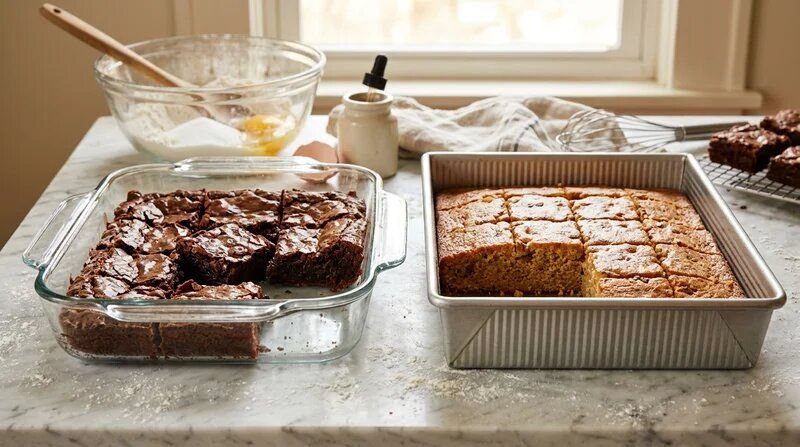
The hallmark of a great brownie is a fudgy, gooey center surrounded by slightly chewy edges. In a light metal pan with 90° straight corners, the entire pan bakes in harmony. In glass, the outer two inches dry out into hard candy-like bark by the time the center loses its raw batter consistency. Check our Brownie Pan Size Calculator when sizing recipes between 8x8 and 9x13 pans.
Breads & Sandwich Loaves
Yeast breads require an intense initial burst of heat—known as "oven spring"—during the first 10 minutes of baking. Metal loaf pans transfer this burst immediately, allowing yeast gas bubbles to expand upward before the crust solidifies. Compare loaf pan volumes with our Loaf Pan Size Calculator.
Popular Metal Bakeware Option
USA Pan Bakeware Aluminized Steel 9x13 Rectangular Cake Pan
Commercial-grade aluminized steel with fluted corrugated surface for airflow, razor-sharp 90° corners, and Americoat non-stick coating for pristine cakes and fudgy brownies.
5. When Glass is the Superior Choice: Casseroles, Pies & Gratins
Despite being tricky for delicate bakery items, glass bakeware is undeniably the champion for wet, savory, acidic, or slow-baked dishes:
1. Casseroles & Lasagnas
Glass dishes excel at holding heat long after leaving the oven. When you bring a bubbling lasagna, baked macaroni and cheese, or green bean casserole to the dinner table, the glass keeps it steaming hot for second helpings. Size your recipe with our Baking Dish Size Calculator.
2. High-Acid Recipes (Tomato & Citrus)
Glass is completely non-reactive. Acidic foods—such as tomato-based enchiladas, lemon-herb roasts, or berry crumbles—can strip metal surfaces, impart a metallic tin flavor, and pit aluminum pans. Glass never reacts.
3. Fruit Pies & Blind Baking
Glass pie plates are the favorite of home pie bakers because they allow you to lift the dish and visually inspect the bottom crust. You can see whether the butter has fully crisped or if it needs 5 more minutes. Verify dimensions with our Pie Pan Size Calculator.
4. Fruit Crisps, Cobblers & Puddings
The steady, penetrating radiant heat of glass thickens cornstarch, flour, and natural fruit pectins evenly without scorching the sugary sauce along the bottom of the dish.
Popular Glass Bakeware Option
Pyrex Deep 9x13-Inch Glass Baking Dish with Lid
50% deeper tempered glass dish designed to eliminate lasagna boil-overs, non-porous and stain-resistant with a secure storage lid for refrigerator leftovers.
6. Light Metal vs Dark Metal Pans: The Hidden Trap
Not all metal pans behave alike. A dark grey or black non-stick pan acts very differently from a reflective silver aluminum pan:
Light-Colored Metal (The Pro Choice)
Silver, natural aluminum pans reflect oven radiant heat. Heat enters gently via conduction, allowing the center and edges to cook at an identical pace. This produces tall, uniform cakes with soft golden crusts.
Dark Non-Stick Metal (The Browning Accelerator)
Dark pigments absorb thermal radiation aggressively. Cookies baked on dark sheets often scorch on the bottom within 8 minutes while the top remains pale dough. If using dark metal pans, lower your oven temperature by 25°F as well!
7. The Critical Risk: Thermal Shock Safety Rules for Glass
Unlike metal, which simply bends or warps under sudden temperature swings, glass can experience catastrophic thermal shock—shattering violently into thousands of sharp fragments across your kitchen.
- Never set hot glass on cold or wet counters: Granite, marble, quartz, and wet stainless steel are cold thermal sinks. Always place hot glass onto a thick dry cloth towel, wooden carving board, or silicone trivet.
- Never pour cold liquid into a hot glass dish: Adding cold broth, water, or wine to a hot pan roasting chicken will trigger localized contraction and instantaneous shattering.
- Never put freezer-cold glass directly into a hot oven: Allow refrigerated or frozen casseroles to sit at room temperature for 30 minutes, or place the dish in a cold oven and allow both to warm up together.
- Never place glass under an oven broiler: Broiler elements emit intense direct radiant heat (over 500°F–550°F), which exceeds the thermal tolerance of tempered glass.
- Never use glass over a direct stovetop flame or burner: Glass is engineered for ambient radiant oven heat, not concentrated conductive stovetop flames.
- Inspect for micro-cracks and chips: Any hairline scratch or chip compromises the structural tempering of the glass. Discard chipped bakeware immediately.
8. Step-by-Step Conversion Checklist: How to Bake in Glass
Follow this standard 4-step checklist when adapting any baking recipe for a glass dish:
Drop Oven Temp 25°F
Turn your oven dial down by 25°F (15°C). If your recipe says 350°F, set it to 325°F. This balances the high radiant heat absorption of glass.
Use a Parchment Paper Sling
Line your glass dish with two criss-crossed sheets of parchment paper leaving overhang wings. This allows you to lift brownies or bars out cleanly without scratching the glass with a knife.
Plan for 5–10 Extra Minutes
Because glass takes 10 to 15 minutes to reach full baking temperature, lower heat baking takes slightly longer. Start checking doneness at the original recipe time.
Safe Cooling Trivet Prep
Place a wooden butcher block, silicone trivet, or folded dry cloth towel on your counter before taking the dish out. Never place hot glass on granite.
Recommended Bakeware Essentials for Every Kitchen
Well-reviewed bakeware workhorses for consistent heat transfer:
Pyrex Deep 9x13-Inch Glass Baking Dish with Lid
50% deeper tempered glass dish engineered to eliminate bubbling lasagna overflows, completely non-porous and thermal shock tempered with a BPA-free storage lid.
USA Pan Bakeware Aluminized Steel 9x13 Rectangular Cake Pan
Commercial-grade aluminized steel with unique fluted corrugated surface for air circulation, straight 90° corners, and Americoat non-stick release.
Nordic Ware Natural Aluminum Commercial Half Sheet Pan
Pure heavy-gauge natural aluminum baking sheet with galvanized steel reinforced rim for superior, even heat conduction without warping.
Pyrex Easy Grab 9.5-Inch Clear Glass Pie Plate
Classic tempered glass pie plate with wide fluted handles, ideal for inspecting golden-brown bottom crusts on fruit and custard pies.
Extra-Thick Heat-Resistant Silicone Countertop Trivet Mats
Food-grade, non-slip honeycomb silicone trivets that protect cold quartz and granite countertops from thermal shock fractures when setting hot glass dishes down.
*Affiliate Disclosure: As an Amazon Associate we earn from qualifying purchases through the product links above at no additional cost to you.
Frequently Asked Questions (FAQ)
Why do you lower oven temperature by 25°F for glass bakeware? ▼
Can you bake brownies in a glass pan? ▼
Is glass or metal better for baking cakes? ▼
What foods are best baked in glass dishes? ▼
What is the difference between light metal and dark metal baking pans? ▼
How do you prevent glass bakeware from shattering from thermal shock? ▼
Related Guides & Tools
Hand-picked next reads on this topic.