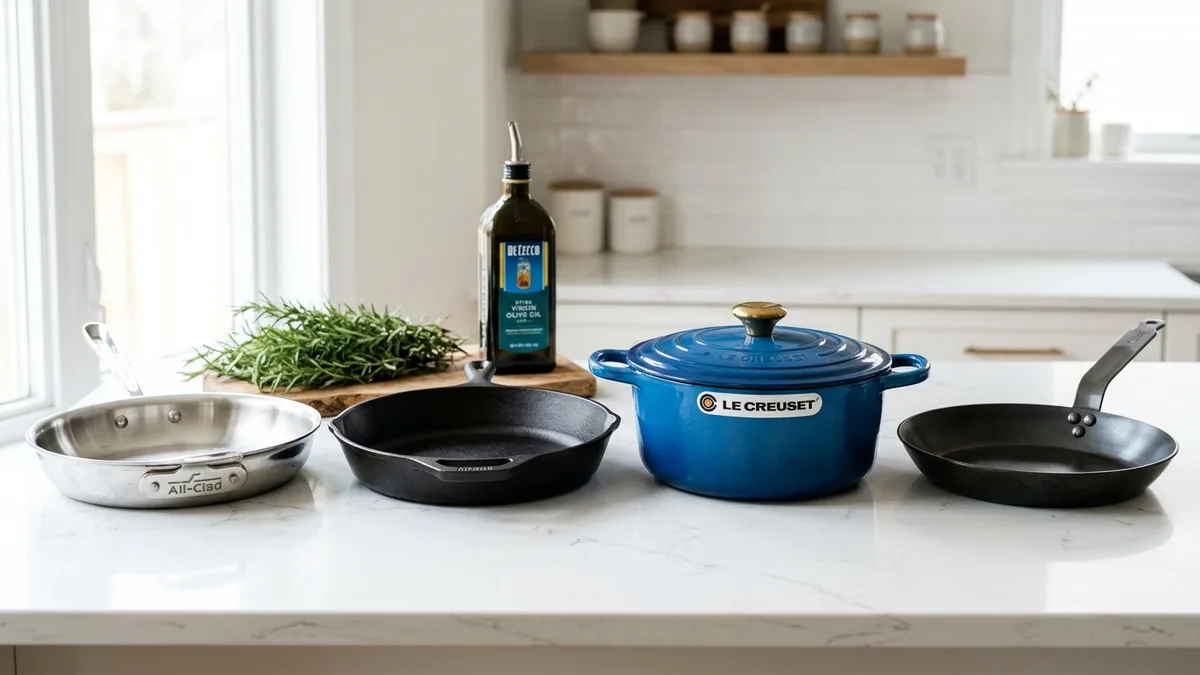
Quick Answer: Which Cookware Material Should You Choose?
No single pan handles every culinary task. Choose tri-ply stainless steel for everyday sautéing, pan sauces, and acidic foods (tomatoes and lemon). Choose seasoned cast iron for high-heat steak searing and baking. Choose enameled cast iron for slow stews and braises. Choose carbon steel for rapid wok tossing, and ceramic or PTFE nonstick strictly for delicate eggs and fish.
1. The 6 Major Cookware Materials: Pros, Cons & Best Uses
Understanding the atomic structure and thermal dynamics of cookware materials transforms your kitchen results. Every material handles energy transfer differently:
1. Tri-Ply & 5-Ply Clad Stainless Steel
Lifespan: 30+ Years (Lifetime)Pure stainless steel is a durable metal, but a poor heat conductor. To fix this, high-performance cookware uses cladding—sandwiching a fast-conducting aluminum or copper core between two exterior sheets of non-reactive 18/10 stainless steel.
- Completely non-reactive to acidic tomatoes, vinegar, and citrus.
- Builds superior fond (browned meat bits) essential for rich pan sauces.
- Oven-safe up to 600°F–800°F; handles metal spatulas with zero damage.
- Requires proper preheating and fat barrier to prevent egg sticking.
- Lower heat retention than thick cast iron when cold proteins are added.
- Requires Barkeepers Friend to remove stubborn rainbow heat tints.
Related analysis: Learn more in our detailed Stainless Steel vs Cast Iron Cookware Comparison.
2. Bare Seasoned Cast Iron
Lifespan: 100+ Years (Heirloom)Cast iron contains 2% to 4% carbon. Its thick, dense walls provide massive thermal mass retention. Once thoroughly heated, it refuses to cool down, ensuring that a cold, thick bone-in ribeye develops a restaurant-grade sear rather than boiling in trapped steam.
- Unmatched searing crust and blistering heat retention.
- Natural non-stick patina improves with continued fatty cooking.
- Extremely economical (quality Lodge skillets cost under $30).
- Heavy (a standard 12-inch skillet weighs over 8 lbs).
- Cannot simmer high-acid sauces without stripping polymerized seasoning.
- Never dishwasher safe; must be dried immediately to stop rust.
Care guide: See our step-by-step tutorial on How to Season a Cast Iron Skillet with Polymerized Oil.
3. Enameled Cast Iron (Dutch Ovens)
Lifespan: 20–50 YearsEnameled cast iron bonds a vitreous glass enamel coating onto heavy iron casting. This combines the superior thermal mass of cast iron with the zero-maintenance, acid-safe inertness of glass. Brands like Le Creuset and Staub are kitchen icons for a reason.
- Zero seasoning needed; handles all-day acidic tomato braises safely.
- Light interior enamel allows effortless monitoring of butter browning.
- Unmatched moisture-locking lids for braising and artisan bread baking.
- Vulnerable to thermal shock (cold water on hot enamel can cause chipping).
- Expensive upfront investment ($100–$400 for top French brands).
- Enamel can chip if struck hard with heavy metal kitchen utensils.
Capacity tool: Size your pot accurately using our Cookware Capacity & Volume Calculator.
4. Blue & Black Carbon Steel
Lifespan: 30+ YearsCarbon steel is the secret weapon of professional restaurant lines and Asian wok cooking. Composed of 99% iron and 1% carbon, it is stamped rather than cast, making it roughly 50% lighter than cast iron with sloped chef sides designed for rapid tossing and sauteing.
- Heats up and responds to temperature adjustments far quicker than cast iron.
- Develops a slippery, dark polymerized non-stick patina very quickly.
- Lightweight enough for one-handed pan flips and wok stir-frying.
- Requires initial seasoning and ongoing oil wiping like cast iron.
- Acidic foods strip the patina and leave a metallic flavor.
- Thinner gauges can warp if cooled rapidly under cold running tap water.
5. Ceramic Nonstick (Sol-Gel Silica)
Lifespan: 1–2 YearsCeramic nonstick is not clay pottery; it is an aluminum pan sprayed with a silica gel derived from sand (Sol-Gel technology). It is completely free from PTFE, PFOA, and forever chemicals, making it widely popular among health-conscious cooks.
- 100% free of PTFE, PFAS, lead, and cadmium forever chemicals.
- Exceptional initial food release with zero oil required.
- Aesthetic matte pastel colors look great on modern stovetops.
- Short lifespan: slickness degrades rapidly after 12 to 18 months of heat.
- Cannot exceed 400°F–450°F without scorching the silica matrix.
- Aerosol cooking sprays cause irreversible sticky resin buildup.
6. Hard-Anodized PTFE Nonstick (Teflon)
Lifespan: 3–5 YearsModern PTFE pans bond fluoropolymer coatings over hard-anodized aluminum (which is twice as hard as stainless steel). It offers the lowest coefficient of friction of any solid material on earth, making it the supreme tool for delicate sunny-side-up eggs.
- The slickest food release available; eggs slide with zero effort.
- Hard-anodized aluminum base delivers rapid, even heat distribution.
- Cleans up in seconds with a soft sponge and warm water.
- Strict 500°F heat ceiling: fluoropolymer degrades and off-gases fumes if overheated.
- Metal utensils cause scratching; wooden or silicone spatulas are required.
- Cannot be seasoned or re-coated; must be discarded once scratched.
2. Thermal Conductivity vs. Thermal Retention: The Cooking Science
To understand cooking, one must understand two contrasting physical properties defined by the National Institute of Standards and Technology (NIST):
Thermal Conductivity (Speed)
Measures how quickly heat moves through a material (in Watts per meter-Kelvin, W/m·K). Copper (385 W/m·K) and Aluminum (205 W/m·K) transfer energy almost instantly, eliminating cold spots. Stainless steel (16 W/m·K) and Cast iron (52 W/m·K) are slow conductors.
Volumetric Heat Capacity (Battery)
Measures how much heat energy a pan stores. Because cast iron is dense and heavy, it acts as a massive thermal battery. When you drop a 40°F cold steak into a hot cast iron pan, the surface temperature barely drops, guaranteeing instant Maillard browning.
3. Materials Science Reference: Heat Capacity, Acid Reactivity & Coating Wear
Oven to Air Fryer Conversion does not operate a physical metallurgy lab; the comparison below summarizes established NIST thermal properties, acid-reaction chemistry, and typical manufacturer lifespan ratings across cookware materials:
1. Surface Temperature Retention Under Cold Protein Load
When a cold cut of meat hits a 450°F pan, surface temperature drop depends on the pan's total heat capacity (mass × specific heat) and gauge thickness:
| Cookware Archetype | Typical Mass (10") | Heat Retention | Burner Recovery Speed | High-Heat Searing Profile |
|---|---|---|---|---|
| Heavy Cast Iron (e.g., Lodge 10.25") | ~5.3 lbs | Highest (Minimal Plunge) | Slower to heat/cool | ★★★★★ Deep Crust |
| Carbon Steel (e.g., De Buyer 10.25") | ~3.8 lbs | High | Responsive & Fast | ★★★★☆ Crisp Golden |
| Tri-Ply Stainless (Aluminum Core) | ~2.6 lbs | Moderate | Rapid (Aluminum Core) | ★★★★☆ Even Fond |
| Thin Nonstick Aluminum (PTFE / Ceramic) | ~1.8–2.2 lbs | Lower (Cools Quickly) | Fast, Lower Ceiling | ★★☆☆☆ Best Medium Heat |
Physics Takeaway: Heavy cast iron's sheer mass acts as a thermal reservoir, helping keep pan temperatures above the ~300°F Maillard browning zone even when cold food is added.
2. Acidic Tomato & Wine Reactivity Chemistry (~4.0 pH)
Low-pH ingredients such as crushed tomatoes (~4.0 pH), lemon juice, and vinegar react very differently depending on surface passivity:
3. Expected Coating Durability & Food Release Lifespan
Typical service expectations under regular home cooking and manufacturer heat limits:
- Tri-Ply Stainless Steel: Multi-decade lifespan. Heat tint and stuck fond clean back to factory shine with oxalic acid cleaners (such as Bar Keepers Friend).
- Bare Cast Iron & Carbon Steel: Renewable surface. Food release improves over time as cooking fats build a tougher polymerized seasoning matrix.
- Hard-Anodized PTFE Nonstick: Commonly lasts 3–5 years when kept below manufacturer ceilings (~450°F–500°F) using silicone or wooden tools.
- Ceramic (Sol-Gel Silica): PTFE/PFAS-free, but owner reviews and manufacturer notes commonly report reduced nonstick release after 1–2 years as thermal cycling wears the silica gel layer.
4. Master Cookware Materials Comparison Table
Here is a reference matrix comparing all six cookware materials across thermal conductivity, acid safety, oven limits, and typical lifespan:
| Material | Conductivity | Heat Retention | Acid Safe? | Max Oven Temp | Dishwasher? | Average Lifespan |
|---|---|---|---|---|---|---|
| Tri-Ply Stainless | Very High (Core) | Moderate | 100% Yes | 600°F–800°F | Yes | 30+ Years |
| Bare Cast Iron | Low (Slow) | Maximum | No (Strips) | 650°F+ | Never | 100+ Years |
| Enameled Iron | Low (Slow) | Maximum | 100% Yes | 500°F | Hand Wash | 20–50 Years |
| Carbon Steel | Fast | High | No (Strips) | 600°F+ | Never | 30+ Years |
| Ceramic Nonstick | Fast | Low | Yes | 400°F–450°F | Hand Wash | 1–2 Years |
| PTFE Nonstick | Very Fast | Low | Yes | 500°F Max | Hand Wash | 3–5 Years |
Also explore our baking guides on Dark vs Light Baking Pans and Glass vs Metal Baking Pans.
5. Interactive Culinary Matcher: Which Pan Should You Use?
Click any dish below to see the recommended cookware material, optimal cooking temperature, and fat pairing:
Maximum Thermal Mass for Crust Development
Thick steaks release substantial surface moisture upon hitting the pan. Cast iron's dense walls store enough caloric heat energy to instantly evaporate that liquid and caramelize proteins into a dark, savory crust.
6. Non-Toxic Safety, PFAS Forever Chemicals & Health Standards
Health safety is now the primary driver for kitchen equipment purchases. According to USDA Food Safety and Inspection Service Guidelines, understanding cookware degradation is critical:
Inert & Non-Leaching: Stainless Steel & Enameled Iron
High-grade 18/10 stainless steel forms a microscopically thin chromium oxide passivation layer that prevents iron or nickel leaching into food under ordinary culinary temperatures. Enameled cookware bonds non-porous glass that is 100% chemically inert.
The 500°F PTFE Breakdown Threshold
Polytetrafluoroethylene (PTFE) begins to thermally degrade above 500°F (260°C). Above 660°F, it decomposes, releasing fluoropolymer fumes that cause temporary polymer fume fever in humans and are fatal to domestic birds. Always heat nonstick pans over low-to-medium heat with food already inside.
Natural Seasoning Polymerization: Cast Iron & Carbon Steel
The non-stick surface on cast iron and carbon steel is not a synthetic chemical; it is created by heating unsaturated fatty acids (such as grapeseed or flaxseed oil) until they cross-link and bond molecularly with the iron in a safe, non-toxic polymer.
7. Care, Cleaning & Longevity Rules
Stainless Steel Care
- Deglaze while hot with wine, broth, or water to lift pan drippings.
- Use oxalic acid powder (Barkeepers Friend) to wipe away cloudy white calcium scale and rainbow heat marks.
- Completely dishwasher safe, but dry promptly to prevent water spotting.
Cast Iron & Carbon Steel Care
- Wash with warm water and mild dish soap (yes, modern dish soap without lye will not harm cured seasoning).
- Dry immediately over a low stovetop flame for 60 seconds.
- Wipe a microscopic drop of high-smoke oil before storing in a dry cupboard.
8. Frequently Asked Questions (FAQ)
Which cookware material is the healthiest and most non-toxic? ▼
18/10 stainless steel, seasoned bare cast iron, and enameled cast iron are the safest and most non-toxic materials. They contain no synthetic PTFE/PFAS coatings, cadmium, or lead, and they will never emit toxic chemical fumes even at 600°F or higher.
Why does food stick to stainless steel and how do you prevent it? ▼
Food sticks to stainless steel because cold food forms microscopic sulfur bonds with tiny porous crevices in the steel. To prevent sticking, use the Leidenfrost water droplet test: preheat the dry pan over medium heat for 2 to 3 minutes until water drops bead into a gliding mercury-like ball, then add oil, wait 15 seconds, and add your food.
Can you cook acidic foods like tomatoes in cast iron? ▼
Quick 10-minute acid deglazes with wine are safe in a well-seasoned cast iron skillet. However, simmering acidic tomato sauce or vinegar for more than 20 minutes strips the polymerized oil seasoning layer and can leach trace dietary iron, giving the sauce a metallic flavor. For long tomato sauces, use stainless steel or enameled cast iron.
Is ceramic nonstick cookware better than traditional Teflon? ▼
Ceramic nonstick is 100% free of PFAS forever chemicals and safe up to 450°F without toxic off-gassing. However, its silica sol-gel surface degrades faster, typically lasting 1 to 2 years under regular use compared to 3 to 5 years for traditional PTFE nonstick.
What is the difference between carbon steel and cast iron? ▼
Carbon steel contains 1% carbon and is stamped from sheet metal, making it roughly 50% lighter than cast iron with sloped sides for easy flipping. Cast iron contains 2% to 4% carbon and is poured into sand molds, making it thicker and heavier with superior long-term heat retention for thick steaks.