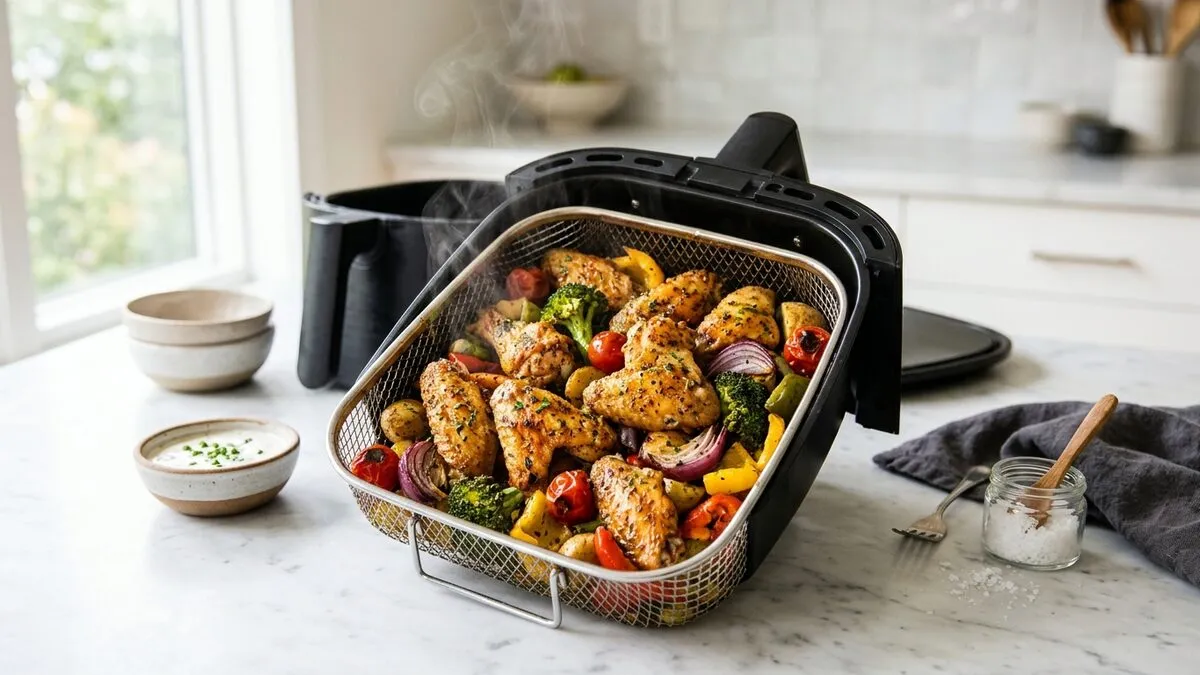
1. Why Air Fryers Cook So Much Faster (Simple Explanation)
An air fryer is essentially a super-compact convection oven with a high-speed fan. In a traditional 30-inch oven, heat radiates slowly through a large space (around 5 cubic feet of air). Because the air moves slowly, food heats up gradually.
In an air fryer, the cooking chamber is tiny (usually 4 to 6 quarts), and a fan spins at over 2,000 RPM right above the heating element. Here is what happens in simple terms:
- It strips away the moisture barrier: As food heats, it releases a thin layer of cold water vapor around its surface. In a standard oven, this steam protects the food from browning quickly. In an air fryer, the powerful wind strips this steam layer away instantly, allowing heat to hit the surface directly.
- Instant Maillard browning: Because moisture evaporates rapidly, the surface temperature quickly climbs above 284°F (140°C). This creates the crispy golden crust we love, requiring up to 80% less oil.
Appliance Comparison: Specs & Thermal Benchmarks
To illustrate how chamber volume affects heating speed, the table below compares published manufacturer specifications and standard thermal estimates across three appliance formats: a 5.8-Quart Basket Air Fryer, a 24-Quart Air Fryer Toaster Oven, and a standard 30-Inch Electric Wall Oven (estimates based on 1,500W–3,500W rated power and $0.16/kWh utility rates; Oven to Air Fryer Conversion does not run an in-house physical testing lab).
| Performance Metric | Basket Air Fryer (5.8 Qt) | Toaster Oven Air Fryer (24 Qt) | Conventional Oven (5 Cu. Ft) |
|---|---|---|---|
| Typical Preheat to 400°F | 2 – 3 mins | 5 – 8 mins | 15 – 18 mins |
| Typical Chicken Breast Cook Time | 15 – 18 minutes | 20 – 23 minutes | 25 – 30 minutes |
| Moisture Retention Profile | High (shorter cook window) | Moderate–High | Moderate (longer dry-heat cycle) |
| Typical Oil Mist for Fresh Fries | 1 – 2 tsp (5–10g) | 1.5 – 2 tsp (7–10g) | 2 tbsp (28g) |
| Estimated Electricity (per cycle) | ~0.55–0.65 kWh ($0.09) | ~0.85–0.95 kWh ($0.14) | ~1.80–2.10 kWh ($0.31) |
Key Physics Takeaway: Compact basket-style air fryers generally cook roughly 20% faster than countertop toaster ovens because the heating coil and fan concentrate airflow into a smaller chamber, reducing overall cooking duration and limiting moisture loss.
2. Master Oven to Air Fryer Conversion Cheat Sheets
Use these food-by-food tables to convert your favorite meals directly. For foods requiring safe internal temperatures, always confirm with the USDA Safe Temperature Chart.
🍗 Chicken & Poultry Conversions
| Food Item | Standard Oven | Air Fryer Setting | Halfway Action | Safe Internal Temp |
|---|---|---|---|---|
| Chicken Wings (Fresh) | 425°F for 40-45m | 390°F for 20-24m | Shake every 7-8m | 165°F (74°C) |
| Chicken Breast (Boneless, 8oz) | 400°F for 25-30m | 375°F for 16-18m | Flip at 9m | 165°F (74°C) |
| Bone-In Chicken Thighs | 400°F for 35-40m | 380°F for 22-25m | Skin down first, flip at 12m | 175°F (Tender) |
| Chicken Tenders / Strips | 400°F for 20-22m | 375°F for 11-13m | Flip at 6m | 165°F (74°C) |
🥩 Beef, Pork & Meat Conversions
| Food Item | Standard Oven | Air Fryer Setting | Halfway Action | Chef Advice |
|---|---|---|---|---|
| Ribeye Steak (1-inch thick) | 425°F for 18-22m | 400°F for 10-13m | Flip at 6m | Preheat 3 mins for crust |
| Thick-Cut Bacon | 400°F for 20-22m | 375°F for 9-11m | No flip needed | Add 2 tbsp water to drawer to stop smoke |
| Pork Chops (Bone-in, 1-inch) | 400°F for 25-28m | 375°F for 14-16m | Flip at 8m | Cook to 145°F, rest 3 mins |
| Beef Meatballs | 400°F for 20-24m | 375°F for 12-14m | Shake at 6m | 160°F internal doneness |
🐟 Seafood & Fish Conversions
| Food Item | Standard Oven | Air Fryer Setting | Halfway Action | Chef Secret |
|---|---|---|---|---|
| Salmon Fillet (6oz, skin-on) | 400°F for 16-20m | 380°F for 9-12m | Skin down, no flip | Brush oil to prevent albumin |
| Raw Peeled Shrimp | 400°F for 12-14m | 380°F for 6-8m | Shake at 4m | C-shape = done; O-shape = overcooked |
| Cod or Haddock Fillets | 400°F for 18-20m | 375°F for 10-12m | Gentle flip at 6m | Use perforated parchment paper |
🥦 Vegetables & Frozen Foods Conversions
| Food Item | Standard Oven | Air Fryer Setting | Halfway Action | Crispness Tip |
|---|---|---|---|---|
| Frozen French Fries | 425°F for 24-28m | 400°F for 14-17m | Shake 2-3 times | No added oil needed |
| Roasted Broccoli Florets | 400°F for 22-25m | 375°F for 10-12m | Shake at 6m | Light oil spray prevents burnt tips |
| Cubed Roasted Potatoes | 400°F for 35-40m | 380°F for 18-20m | Shake at 10m | Parboil 4 mins for ultra crunch |
| Frozen Mozzarella Sticks | 400°F for 12-14m | 370°F for 6-7m | Shake at 4m | Pull out before cheese bursts |
3. The 7 Golden Rules for Air Fryer Success
Rule 1: Never Overcrowd the Basket
Piling food several layers deep traps steam and turns your air fryer into a steamer. Always arrange items in a single layer with breathing room. If you are cooking for a family, use our Air Fryer Capacity Calculator to find the ideal batch size.
Rule 2: Drop 50°F for Baked Desserts
While savory food needs a 25°F drop, baked items (cakes, muffins, brownies) need a 50°F (25°C) reduction. Because the heating element sits just inches above the pan, a standard temperature will burn the top before the middle cooks through.
Rule 3: Use an Oil Sprayer, Not Aerosol Cans
Aerosol cooking sprays (like Pam) contain propellants and emulsifiers (soy lecithin) that bake into the non-stick coating and cause peeling. Instead, use a refillable pump sprayer filled with avocado oil or light olive oil. Learn more in our guide: Can You Use Oil in an Air Fryer?.
Rule 4: Stop White Smoke with the 2-Tablespoon Water Trick
Cooking fatty meats like bacon or 80/20 burgers can cause grease to drip onto the hot bottom pan and smoke. Add 2 tablespoons of water or a slice of bread to the bottom drawer before cooking to absorb fat and eliminate smoke. See full troubleshooting in our guide: Why Is My Air Fryer Smoking & How to Fix It.
Rule 5: Always Use Perforated Parchment Paper
Regular solid parchment paper blocks the air holes at the bottom of the basket, preventing crisping. Always use perforated liners. Warning: Never put parchment paper in the basket during preheat without food weighing it down, or the fan will suck it into the red-hot heating coil.
Rule 6: Master the Midway Shake or Flip
Even though air circulates around the basket, the top radiant heating element is much hotter than the bottom. Shaking smaller foods (fries, nuggets) or flipping larger items (steaks, chicken breasts) at the 50% mark ensures identical crispness on both sides.
Rule 7: Check 3 to 5 Minutes Early
Air fryer wattages vary from 1,200W to 1,800W. To prevent overcooking, always slide the basket open 3 to 5 minutes before your calculated cooking timer ends and check with an instant-read meat thermometer. You can browse reference cooking times in our master Air Fryer Cooking Times Chart.
Top-Rated Air Fryers Worth Comparing
Selected based on published airflow specs, temperature range, and durable nonstick baskets
Reaches true 400°F in under 2 minutes with superior air circulation that outperforms bulkier toaster styles.
Ultra-quiet 360° air circulation system with tempered glass touchscreen and dishwasher-safe basket.
Built-in viewing window and internal light lets you check doneness without opening the basket and releasing heat.
Frequently Asked Questions About Converting Oven to Air Fryer
What is the standard formula for converting oven cooking to an air fryer? ↓
The universal rule is: Lower the oven temperature by 25°F (15°C) and reduce total cooking time by 20% to 25%. For delicate baked desserts (such as cakes and muffins), reduce temperature by 50°F (25°C) to prevent the top crust from burning before the center expands.
Do I really need to flip food halfway through? ↓
Yes! While hot air circulates under the basket mesh, the direct infrared radiant heat comes primarily from the heating coil at the top. Flipping meat, fish, and pastries ensures both sides experience uniform browning and crispness.
Can I put pyrex, glass, or ceramic bakeware inside an air fryer? ↓
Only if the dish is labeled oven-safe up to 450°F. However, thick glass and ceramic pans act as thermal insulators, slowing down heat transfer to the bottom of your food. For best results, use dark, lightweight anodized aluminum or silicone air fryer liners.
Why did my air fryer start smoking when cooking bacon or burgers? ↓
High-fat foods render grease that collects in the drawer. The high-speed vortex pulls grease droplets into the red-hot heating coil, producing thick white smoke. Stop this by pouring 2 tablespoons of water or placing a slice of bread into the bottom catch tray before cooking.
How much electricity does an air fryer use compared to a conventional oven? ↓
A standard electric oven draws 3,000 to 5,000 watts and takes 15 minutes just to preheat. A typical air fryer draws only 1,500 to 1,750 watts and finishes cooking in half the time, slashing your kitchen cooking energy consumption by up to 70%.