Table of Contents
- 1. Master Oil Smoke Point Chart
- 2. Thermal Behavior & Residue Chemistry at 400°F
- 3. Top-Rated High-Heat Oils & Non-Aerosol Sprayers
- 4. What Happens When Oil Smokes?
- 5. Smoke Point vs. Oxidative Stability
- 6. Air Fryer Oil Rules & Aerosol Dangers
- 7. Cast Iron & Stainless Steel Searing
- 8. Interactive Culinary Oil Matchmaker
- 9. Frequently Asked Questions
1. Master Cooking Oil Smoke Point & Temperature Chart
Not all cooking oils react equally under thermal stress. Refining processes strip away moisture, volatile free fatty acids, and particulate plant solids, dramatically elevating the smoke point. Below is our reference comparison compiled from published AOCS lipid-science tables and refiner data, sorted from highest smoke point to lowest.
| Cooking Fat / Oil | Smoke Point (°F) | Smoke Point (°C) | Primary Fat Type | Best Kitchen Use |
|---|---|---|---|---|
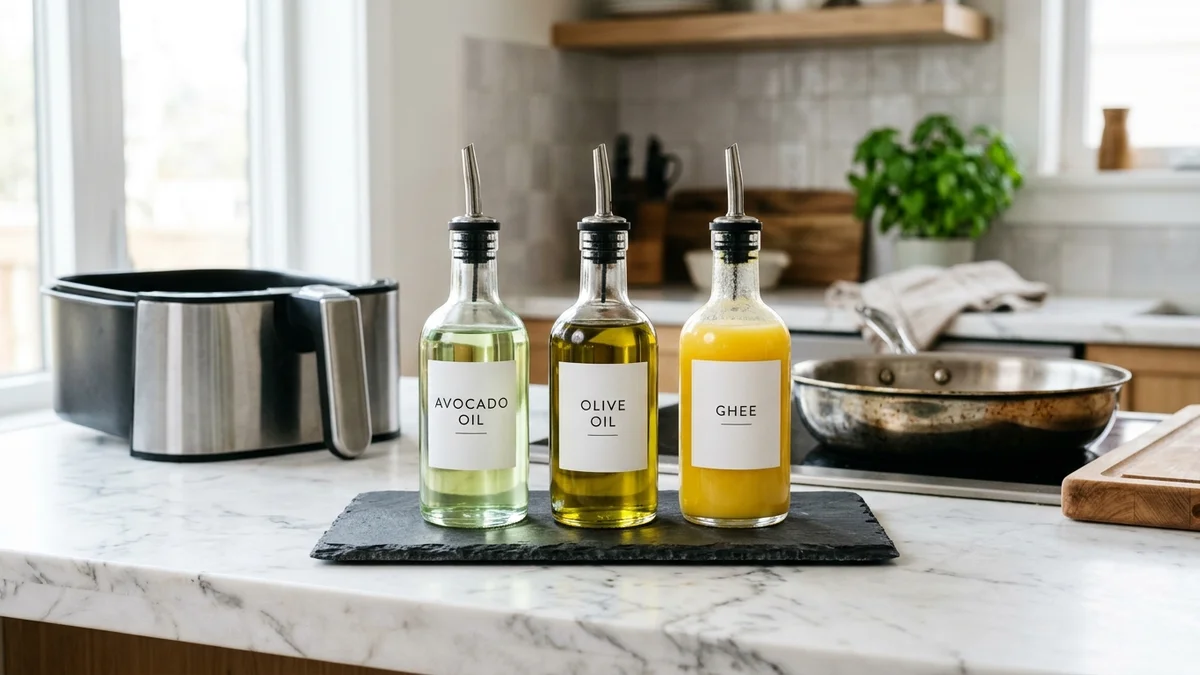
| Avocado Oil (Refined) | 520°F | 271°C | Monounsaturated (70%) | 400°F air frying, high-heat steak searing, deep frying |
| Safflower Oil (Refined) | 510°F | 266°C | Polyunsaturated (75%) | Commercial frying, neutral stir frying |
| Ghee (Clarified Butter) | 485°F | 252°C | Saturated / Mono (65%) | Pan-searing ribeyes, roasting vegetables, rich nutty aroma |
| Rice Bran Oil | 490°F | 254°C | Balanced Mono/Poly | Crispy tempura, high-temperature wok cooking |
| Light / Pure Olive Oil (Refined) | 465°F | 240°C | Monounsaturated (73%) | Everyday roasting, sautéing, air fryer basket brushing |
| Peanut Oil (Refined) | 450°F | 232°C | Monounsaturated (48%) | Southern deep-fried turkey, air fryer chicken wings |
| Corn & Soybean Oil | 450°F | 232°C | Polyunsaturated (58%) | Commercial deep fryers, standard baking |
| Beef Tallow (Rendered) | 420°F | 215°C | Saturated Fat (50%) | Legendary french fries, Smash burgers, cast iron seasoning |
| Canola Oil (Expeller-Pressed) | 400°F–425°F | 204°C–218°C | Monounsaturated (62%) | Everyday budget air frying, waffle irons, quick sautés |
| Extra Virgin Olive Oil (EVOO) | 375°F–410°F | 190°C–210°C | Oleic Acid + Polyphenols | 350°F air frying, roasted veggies, dressings, finishing |
| Coconut Oil (Refined) | 400°F | 204°C | MCT Saturated (85%) | Dairy-free baking, coconut crust shrimp |
| Virgin Coconut Oil (Unrefined) | 350°F | 177°C | Unrefined Saturated | Gentle stovetop simmering, topical baking |
| Whole Butter (Unsalted) | 302°F–350°F | 150°C–177°C | Saturated (contains milk solids) | Basting steak in final 60 seconds, delicate baked pastries |
| Unrefined Flaxseed & Walnut Oil | 225°F–320°F | 107°C–160°C | Omega-3 Polyunsaturated | Cold salad dressings ONLY. Never heat! |
2. Thermal Behavior & Coating Residue Chemistry at 400°F
Oven to Air Fryer Conversion does not operate an in-house lab; instead, the comparison below synthesizes published American Oil Chemists' Society (AOCS) smoke-point benchmarks, manufacturer care guidelines (such as Ninja and Cosori basket warnings), and chemical behavior under 400°F forced-air convection.
| Cooking Fat / Format | Smoke Margin at 400°F | Thermal Degradation Risk | Non-Stick Basket Effect | Flavor Impact | Reference Verdict |
|---|---|---|---|---|---|
| Refined Avocado Oil (Pure) | +120°F Margin (520°F SP) | Very Low at 400°F | Clean Wash (No Propellants) | Neutral | Top thermal headroom for 400°F–450°F air frying. |
| Clarified Butter / Ghee | +85°F Margin (485°F SP) | Very Low (Curds Removed) | Clean Wash (Fat Soluble) | Rich & Nutty | Browned-butter notes without burning milk solids. |
| High-Oleic Canola Oil | 0°F to +25°F (400–425°F) | Low-Moderate | Standard Oil Film | Neutral | Solid budget choice for everyday 350°F–400°F crisping. |
| Extra Virgin Olive Oil | -25°F to +10°F (375–410°F) | Moderate (Polyphenol Protected) | Normal Soap Wash | Fruity / Savory | Best kept at 350°F–375°F for veggies & Mediterranean dishes. |
| Unsalted Whole Butter | -50°F to -98°F Deficit | Rapid Milk-Solid Scorching | Charred Casein Specks | Bitter / Burnt | Milk proteins scorch well below 400°F; finish post-cook. |
| Aerosol Sprays (with Lecithin) | Emulsifier Polymerizes | High Additive Breakdown | Gummy Polymer Buildup | Chemical / Off | Avoid in baskets! Soy lecithin bakes onto PTFE/ceramic. |
Manufacturer care manuals consistently warn against propellant aerosol sprays because soy lecithin emulsifiers polymerize into a sticky glaze on heated non-stick coatings. Pure refined avocado oil and clarified ghee avoid additives altogether and handle 400°F convection comfortably.
3. Recommended High-Heat Cooking Oils & Non-Aerosol Sprayers
Based on published smoke-point specs, fatty-acid stability, and verified buyer durability feedback, here are top options for air frying, searing, and basket protection:
1. Best Overall for Air Fryers: Chosen Foods 100% Pure Avocado Oil
520°F Smoke PointA widely favored choice for high-heat air frying. Made from 100% pure Hass avocados, it delivers a massive 520°F (271°C) thermal cushion with 10 grams of heart-healthy monounsaturated fat per serving. It produces minimal smoke in 400°F air fryer cycles and allows crisp browning without imparting heavy flavor. You can check pricing and size options for Chosen Foods 100% Pure Avocado Oil on Amazon.
2. Best for Cast Iron Steak Crusts: 4th & Heart Grass-Fed Ghee
485°F Smoke PointStandard butter burns at 302°F because of water and milk solids. 4th & Heart slow-clarifies pasture-raised New Zealand butter, completely filtering out lactose and casein. The result is pure golden butterfat with a 485°F smoke point that creates unbeatable restaurant-grade Maillard crusts on cast iron steaks and roasted vegetables. Find 4th & Heart Grass-Fed Ghee on Amazon.
3. Essential Air Fryer Accessory: Evo Non-Aerosol Oil Sprayer Bottle
Protects Non-Stick CoatingThe permanent fix for peeling, sticky air fryer baskets. Commercial aerosol cans (like PAM) use chemical propellants and soy lecithin that bake into non-stick surfaces as gummy varnish. The Evo sprayer delivers a precise, calibrated 1/4 teaspoon fan spray of pure oil with zero chemical additives. Fill it with avocado or light olive oil for effortless coating on french fries, wings, and vegetables. View the Evo Non-Aerosol Oil Sprayer on Amazon.
4. The Chemistry: What Happens When Oil Exceeds Its Smoke Point?
When you heat fat in a pan or circulate it with 400°F convective air in an air fryer, thermal energy continuously bombards the lipid molecules. Every oil has a specific threshold where triglycerides split apart into glycerol and individual free fatty acids (FFAs).
Acrolein Gas Release
Glycerol decomposes into acrolein, an eye-watering, throat-irritating compound responsible for the pungent, burnt smell of scorched fat.
Bitter Degradation
Volatile aldehydes and ketones form instantly, ruining your food's flavor profile with a harsh, bitter, acrid aftertaste that cannot be seasoned away.
Polar Compound Surge
Free radicals and oxidized lipid polymers multiply. Consistent consumption of over-smoked oils increases digestive inflammation.
If your air fryer or skillet ever fills the kitchen with a bluish haze, you have pushed the oil past its thermal breakdown limit. Pull the appliance from power or lift the pan immediately. Check our guide on why an air fryer smokes and how to stop it.
5. The Modern Revelation: Smoke Point vs. Oxidative Stability
For decades, home cooks were told: "Never cook with extra virgin olive oil because its smoke point is only 375°F to 410°F." Modern lipid chemistry from the American Oil Chemists' Society (AOCS) and peer-reviewed food laboratories has disproven this simplistic myth.
Why Smoke Point Alone Does Not Equal Cooking Safety
Refined seed oils (such as corn, soybean, and cheap vegetable blends) often boast high smoke points (450°F) because all solids were stripped with chemical hexane solvents. However, they are packed with delicate polyunsaturated fatty acids (PUFAs) containing fragile double carbon bonds. Under sustained oven or air fryer heat, these bonds shatter, generating significant total polar compounds (TPCs) before visible smoke appears.
In contrast, high-grade Extra Virgin Olive Oil consists primarily of monounsaturated oleic acid (73%) fortified with natural polyphenols and vitamin E tocopherols. These natural antioxidants sacrifice themselves to protect the fat, giving EVOO extraordinary oxidative stability up to 375°F–390°F.
6. Crucial Air Fryer Rules: Why Aerosol Sprays Destroy Baskets
An air fryer functions very differently from a conventional radiant oven. A 1500-watt to 1800-watt heating coil sits merely 2 inches above your food while a high-velocity fan circulates air at up to 30 miles per hour. This violent convection presents two critical oil hazards:
Never use aerosol canned cooking sprays on your air fryer basket. Commercial aerosols contain soy lecithin as an anti-foaming agent alongside propellants (isobutane, propane). Under high-velocity convection, lecithin carbonizes into a permanent, sticky brown gummy varnish that bonds to Teflon and ceramic non-stick coatings. Once baked on, this gummy film destroys non-stick properties and cannot be scrubbed off without stripping the coating.
The Pro Solution: Purchase the Evo Non-Aerosol Refillable Sprayer Bottle and fill it with pure 100% avocado or light olive oil.
How Much Oil Do You Actually Need?
Unlike deep fryers, air fryers require minimal fat. Adding too much oil causes excess grease to pool in the bottom drawer, where the roaring convection fan atomizes it onto the red-hot bare heating element, creating acrid white smoke. Review our exact benchmarks in how much oil to use in an air fryer and our guide to best and worst oils for air fryers.
- ✔ Pre-toss in a bowl: Always toss vegetables and potatoes in 1 to 2 teaspoons of oil in a mixing bowl before loading them into the basket. This ensures micro-thin, even coverage without oil pooling (essential for crispy air fryer french fries).
- ✔ Convert oven recipes accurately: When adapting standard oven recipes, reduce cooking oil by 50% to 75% and drop the temperature by 25°F using our Oven to Air Fryer Conversion Calculator.
- ✔ The Water Trick for High-Fat Meats: When cooking bacon, 80/20 burgers, or duck, pour 2 tablespoons of water or place a slice of bread in the bottom drip drawer beneath the crisper plate to absorb rendered grease before it vaporizes.
7. Pan Searing Rules: Cast Iron vs. Stainless Steel
When searing protein in heavy cookware, the interaction between surface temperature and oil smoke point determines whether you get a crunchy mahogany crust or a burnt mess:
Cast Iron Skillet Searing
Cast iron holds massive thermal energy, often reaching 450°F to 520°F when searing a thick-cut steak.
- Best Fat: Refined Avocado Oil or Grass-Fed Ghee.
- Technique: Preheat the pan completely dry for 5 minutes. Add oil only seconds before the seasoned meat hits the pan. Learn more in our cast iron seasoning guide.
- Butter Rule: Add 1 tablespoon of butter with garlic and thyme only in the final 60 seconds to baste without burning milk solids.
Stainless Steel Deglazing
Tri-ply stainless steel responds quickly to heat changes and excels at building fond for pan sauces.
- The Mercury Ball Test: Preheat until a water droplet glides like mercury across the pan (the Leidenfrost effect at ~379°F). Check our cookware materials guide.
- Best Fat: High-oleic canola oil or light olive oil.
- Deglazing: Once chicken or pork is browned, splash dry white wine or stock into the pan to lift caramelized browned bits into a silky sauce.
8. Interactive Oil Matchmaker: Pick Your Cooking Task
Click on your intended cooking method to discover the exact chef-recommended oil, target temperature, and pro safety notes:
Avocado oil is the supreme choice for 400°F air frying. Because rapid convection air drives intense surface evaporation, avocado oil’s 520°F thermal cushion prevents smoking while providing even, golden Maillard browning across chicken tenders, roasted broccoli, and fries.
9. Frequently Asked Questions (FAQ)
What is the single best oil for air fryers? ▼
Refined avocado oil is the undisputed #1 oil for air fryers. Its huge 520°F smoke point gives you complete peace of mind that it will never smoke, degrade, or release acrolein even if small droplets blow near the top heating element.
Can I use olive oil in my air fryer? ▼
Yes! Refined "light" or "pure" olive oil has a smoke point of 465°F (240°C) and handles any air fryer temperature. Authentic Extra Virgin Olive Oil (EVOO) has a smoke point of 375°F to 410°F and is perfectly safe for vegetable and chicken roasting at 350°F to 375°F due to its high antioxidant content.
Why does butter burn so quickly in a skillet or air fryer? ▼
Standard butter is not pure fat—it contains roughly 16% water and 2% milk solids (whey and casein protein). These proteins begin scorching and blackening at just 302°F (150°C). If you want rich butter flavor at 485°F without burning, use clarified butter (ghee), where all water and milk solids have been strained away.
How should cooking oils be stored to preserve smoke points? ▼
Light, heat, and oxygen cause rancidity and free fatty acid accumulation, which steadily drops an oil's smoke point over time. Always store oils in dark glass or metal containers in a cool pantry away from the heat of your stove or oven.
Can you use sesame oil in an air fryer? ▼
Refined sesame oil has a smoke point of 410°F and can be used for light Asian cooking. However, toasted dark sesame oil has a low smoke point (350°F) and fragile aromatic compounds—it should strictly be used as a finishing drizzle after cooking, never heated in the air fryer.